Electrolyte Substrates

Electrolyte Substrates

Ceramic electrolyte substrates synthesized in a range of sizes and shapes, enabling compatibility with diverse cell configurations and applications.

Electrolyte Specification

Comparison of key material properties across various electrolyte compositions, including mechanical strength, thermal expansion, and ionic conductivity.

Properties
3YSZ
5YSZ
8YSZ
6ScSZ
10ScSZ
10Sc1CeSZ
Dopant Content (mol%)
Yttria,
3%
Yttria,
5%
Yttria, 8%
Scandia, 6%
Scandia, 10%
Scandia 10%, Ceria1%
Crystal Structure
Tetragonal
Tetragonal + Cubic
Cubic fluorite
Cubic fluorite
Cubic fluorite
Cubic fluorite
4-pt Bending Strength *
1.277 kgf ‡
0.834 kgf
0.398 kgf
1.277 kgf ‡
0.472 kgf
0.697 kgf
Coefficient of Thermal
Expansion (30-1000℃)
10.9 ppm/K
10.7 ppm/K
10.7 ppm/K
10.5 ppm/K
10.5 - 10.7 ppm/K
10.7 - 10.8 ppm/K
Conductivity (850℃) *
0.019 S/cm
0.042 S/cm
0.068 S/cm
0.090 S/cm
0.181 S/cm
0.161 S/cm
Thickness
130 µm
110 µm
110 µm
112 µm
105 µm
120 µm
* Internally measured
† According to literature
‡ Maximum load reached; electrolyte specimen did not fracture during 4‑point bending test.

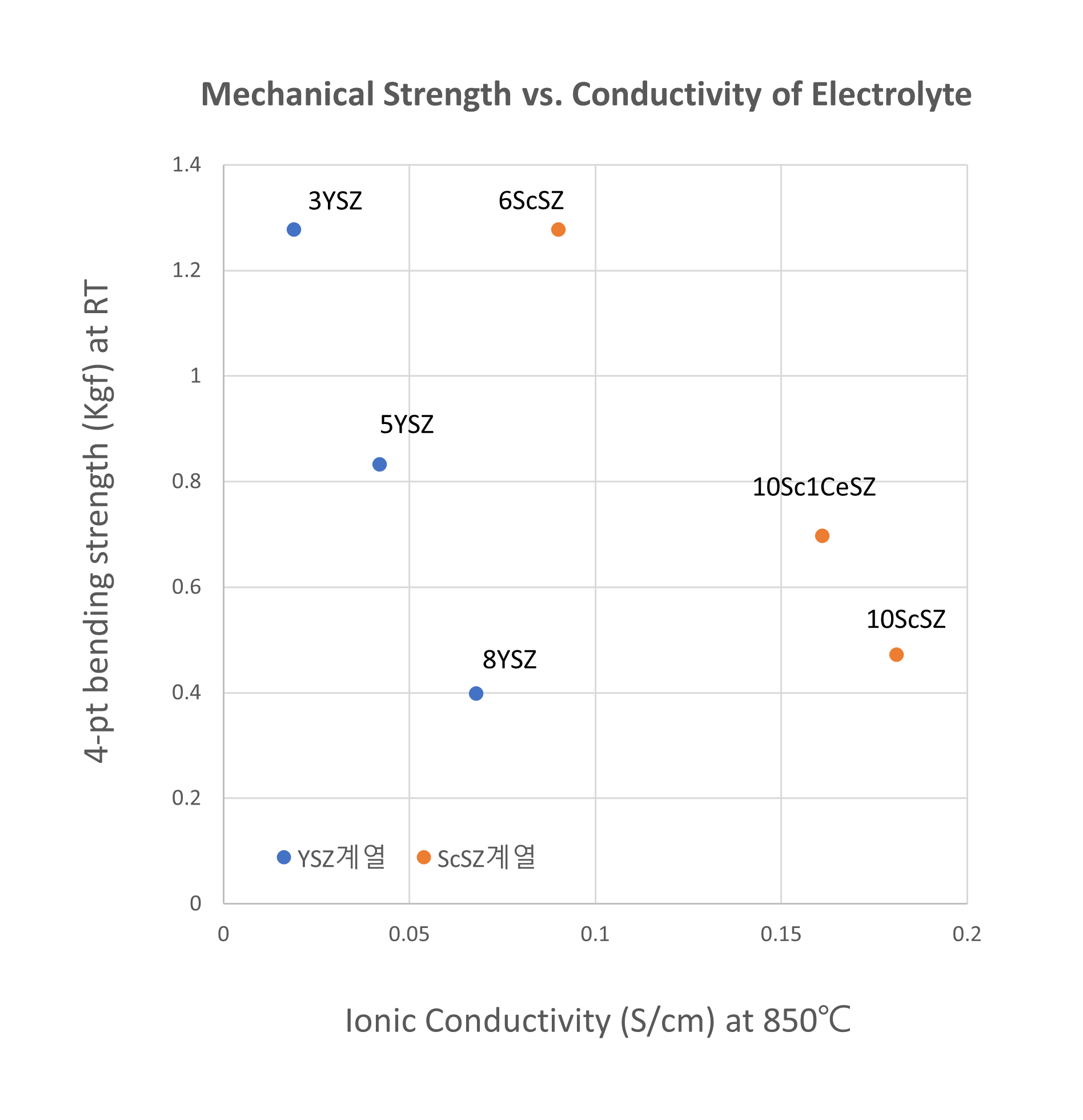
Mechanical Strength vs. Ionic Conductivity

Correlation between 4-point bending strength and ionic conductivity for various electrolyte compositions, illustrating material-dependent performance characteristics.
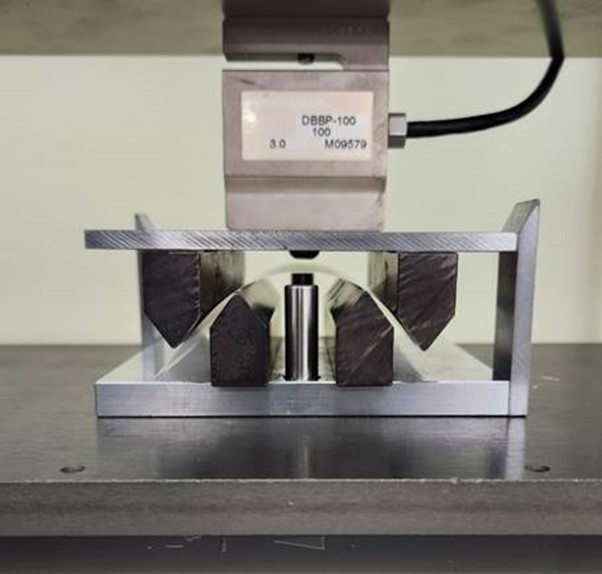
4-Point Bending Test

Mechanical strength evaluation of electrolyte substrates under 4-point bending, demonstrating robust structural integrity under applied load. The image below illustrates a 6ScSZ electrolyte substrate (112 µm thick) sustaining maximum applied load without fracture during the 4-point bending test.